Baccarat Online: Rules, Live Dealer Tables, Demo Play and Real Money Games (2026 Guide)

"Before you deposit a single rupee or claim a welcome banner, check the withdrawal terms and the game contribution rates. In online baccarat, clarity on payout mechanics, table limits and legal context matters far more than promotional promises." Nisha Rao, Casino and Betting India

Last updated: February 2026 · Reviewed for: rules accuracy, payout mathematics, payment and compliance context


Provider

NetEnt / Evolution Gaming

RTP

98.94%

Volatility

Low

Min bet

₹50

Max bet

₹500,000 and above

Max win

9,000x bet
Baccarat Online Rules, Live Dealer Tables

The five things that actually matter

  • The game is a two-hand comparison, not a skill contest. You bet on Player, Banker or Tie, and the hand closest to 9 wins. Drawing decisions are automated, so there is nothing to "play wrong."
  • Banker is mathematically the best main bet: a 1.06% house edge after the 5% commission, versus 1.24% for Player and 14.36% for a standard 8:1 Tie.
  • Demo mode teaches mechanics, not money management. Virtual credits behave differently from a real bankroll, and research links simulated play to higher rates of gambling harm later on.
  • Bonuses are usually built for slots. Baccarat frequently contributes only 0 to 10% toward wagering, so a "₹50,000 bonus" can require millions in turnover. Cashback usually beats deposit matches for baccarat players.
  • India-specific reality check: state law varies, the national Promotion and Regulation of Online Gaming Act 2025 restricts real-money online games, and winnings from online games are taxed at a flat 30% with TDS deducted on net winnings.
The five things that actually matter

Quick glossary: baccarat terms you will see on screen

TermWhat it means
Punto / BancoItalian and Spanish terms for "Player" and "Banker", meaning the two betting positions, not people
CoupA single completed round (hand) of baccarat
NaturalA two-card total of 8 or 9. The round ends immediately with no further cards
Vigorish (vig, commission)The 5% fee the house takes from winning Banker bets
PushA returned stake, which is what happens to Player and Banker bets when the round is a Tie
ShoeThe dealing box holding 6 to 8 shuffled decks
SqueezeThe slow, theatrical reveal of card corners by a live dealer
Roadmap / Bead Plate / Big RoadOn-screen history grids showing previous results
House edgeThe casino's long-run mathematical advantage on a given bet
Commission-free / EZ BaccaratVariants that pay Banker 1:1 but reduce or push the payout when Banker wins with 6

Historical note: from Italian tarot cards to Punto Banco

Invented more than 500 years ago in Italy, with a name derived from the Italian baccara, meaning "zero", the game was originally played with tarot cards. In the 15th century it travelled to France, where it became known as Chemin de Fer and turned into an exclusive amusement of the aristocracy at the court of King Charles VIII. Only much later did it evolve into the fixed-rule, casino-banked Punto Banco that dominates online lobbies today, and into the high-limit halls of Macau and Las Vegas.

Worth noting: almost nothing about the modern online version is aristocratic. It is a fast, low-edge card game with a fixed rulebook, and that is precisely why it travels so well to mobile screens.

Historical note from Italian tarot cards

What baccarat is and how to choose your format

Baccarat is a card-comparing game played between two hands, the Player and the Banker. The objective is to bet on which hand finishes closest to 9, or whether the round ends in a Tie. You are not dealt "your own" cards, and you never decide whether to draw: both hands follow a fixed rulebook. In modern online casinos, baccarat is primarily offered as Punto Banco, a fixed-rule variant where neither the player nor the dealer makes discretionary drawing decisions.

"The banker's commission parameter directly determines the Nash equilibrium and the expected value of baccara bets." Ethier & Lee, "A game-theoretic analysis of baccara chemin de fer, II", Games 14(5), 63 (2023). https://arxiv.org/abs/2308.00118

Selecting the right format depends on your goal. Risk-free practice points you toward baccarat demo modes. Real-money play brings in cash deposits, withdrawal rules and promotional terms, and each of those deserves a read before you register.

When evaluating baccarat online, players meet four main digital presentation types: software-driven Random Number Generator (RNG) tables, RNG demo versions, live streams from land-based casino floors, and studio-based baccarat live dealer tables. For Indian users, format choice dictates not only the speed of play but also account registration requirements, Know Your Customer (KYC) identity checks and payment processing flows under current regulatory frameworks, including the Promotion and Regulation of Online Gaming Act 2025 and its 2026 Rules.

Selecting the right format depends on
baccarat demo vs baccarat real money format guide
Player route: test the mechanics in demo -> check limits and KYC -> live tables for real money

Baccarat demo: free play before your first deposit

Baccarat demo is a zero-risk software mode that uses fictitious virtual credits. It lets you practise the game rules, test side bets and learn the table layout without financial exposure. In demo mode no real-money deposit is required, and session outcomes have zero impact on an actual bankroll.

Demo play usually mirrors the graphical interface and payout logic of RNG real-money tables, which makes it a genuinely useful training ground for beginners. It is worth knowing, however, that free play is not psychologically neutral:

"Engagement in simulated gambling is associated with higher levels of harm from monetary gambling." "Order of first-play in simulated versus monetary gambling", PubMed (2023). https://pubmed.ncbi.nlm.nih.gov/38032384/

Treat demo mode as a rulebook simulator, not as a forecast of results. Virtual credits reset for free. Real balances do not. Free demo modes also carry specific operational boundaries:

  • No withdrawals:virtual winnings cannot be converted into cash or transferred to an external account.
  • Separation from live tables:live dealer streams rarely offer unlimited free play because of bandwidth and studio operating costs. Some suppliers publish "First Person" software versions of their live titles (Evolution's First Person range is the best-known example) that share the live table's look and paytable and include a button to switch across to the streamed table. Availability of any such transition depends on the operator's lobby configuration, so verify it in the game info panel rather than assuming it.
  • Promotional ineligibility:demo wagers do not qualify for casino bonuses, loyalty points or VIP cashback tiers.
  • Educational purpose:demo modes exist to familiarise users with drawing rules (the third-card rule), hand values and software controls before any real-money transaction.
Deltin7 Sport heading-banner

One small observation from testing lobbies: demo mode rarely teaches pace. You click faster than you ever would with your own money, and that habit does not transfer well.

Baccarat real money: what changes when you play for cash

Baccarat real money play requires account registration, identity verification (KYC), a deposit in real currency, and exposure of personal funds to the house edge on every hand. Moving to real money unlocks cash payouts, live dealer access and promotional eligibility. It also introduces financial risk and strict operator compliance checks. Before you register at a real-money online casino, read the cashier and verification pages, not just the bonus banner.

When you play for cash, several practical factors come into focus:

  1. Minimum and maximum limits: real-money tables set strict stake caps, typically from ₹50 (about $1) on RNG tables to ₹500,000 and above at VIP live dealer tables. Published live baccarat ranges commonly sit between $1 and $10,000 per hand depending on the table tier.

  2. Account verification and KYC: operators require official identity documents (Aadhaar, PAN or passport in India) before processing withdrawal requests, in line with anti-money laundering (AML) standards.

    "Cryptocurrencies and prepaid cards present the highest AML risks because of the difficulty of verifying the source of funds." UNLV International Gaming & Casino Research Center, "Online Casinos, Alternative Payment Mechanisms and the Finance Crime Risks" (2024). https://www.unlv.edu/sites/default/files/media/document/2024-07/IGCR-OnlineCasinos-AlterPaymentMechanisms-FinanceCrimeRisks.pdf

    In practice this means crypto and prepaid deposits often trigger deeper documentation requests at withdrawal than a bank transfer or a UPI payment from an account in your own name.

  3. Payment friction: real-money deposits depend on supported local and international channels, including UPI, NetBanking, Skrill, Neteller, credit and debit cards, and cryptocurrency.

  4. Bonus wagering restrictions: promotional funds used on real-money baccarat often face reduced wagering contribution rates, typically 0% to 10%, which stretches the turnover required before you can cash out.

    "High wagering requirements attached to bonuses lead to more intense play and create complexity that increases the risk of harm." "The Importance of Welcome Bonus Value in Player Protection and Consumer Protection: A UK Perspective", preprint (2023). https://d197for5662m48.cloudfront.net/documents/publicationstatus/312115/preprint_pdf/ea580c629b198b3cb2dbe62e3df4e1fc.pdf

Baccarat real money what changes when

Baccarat demo vs baccarat real money

Feature / AspectBaccarat demo (free play)Baccarat real money
Financial riskZero; played with virtual play-money creditsFull risk; wagers deducted from a deposited cash balance
Registration / KYCOften accessible without an account or verificationFull account registration and identity verification required
Live dealer accessVery limited, or restricted to First Person softwareFull access to HD live dealer streams and interactive tables
Withdrawal capabilityNone; a virtual balance cannot be cashed outWithdrawals permitted subject to KYC and wagering compliance
Bonus qualificationIneligible for promotional offers or loyalty rewardsEligible for welcome offers, cashback and reload promotions
Minimum stakeNone; virtual credits reset on demandOperator-defined minimums, for example ₹50 to ₹500 per hand
Primary objectiveLearning rules, testing software, practiceCommercial play with real financial gains and losses

Baccarat rules: how a hand is dealt and who wins

In standard baccarat, two two-card hands are dealt, one to the Player position and one to the Banker position. The hand with a point total closest to 9 wins the round. If both hands end with identical totals, the result is a Tie, and active stakes on Player and Banker are returned as a push.

The dealing sequence is strict: the dealer, or the RNG engine, deals one card to the Player, one to the Banker, a second to the Player and a second to the Banker. Card values are then summed. If the initial two-card total of either hand equals 8 or 9, it is declared a "Natural." When a Natural occurs, the round ends immediately and no additional cards are dealt, per the Nevada Gaming Control Board's Live Baccarat Rules of Play (2026).

Baccarat rules how a hand is

The objective and card values in baccarat

The primary objective is to predict which outcome, Player, Banker or Tie, will finish closest to 9. Card values do not follow poker rankings:

  • Aces:count as 1 point.
  • Cards 2 through 9:count at face value, so a 7 is worth 7 points.
  • 10s, Jacks, Queens and Kings:count as 0 points.
The objective and card values in
baccarat card values and point calculation example
How a hand total is calculated once tens are dropped

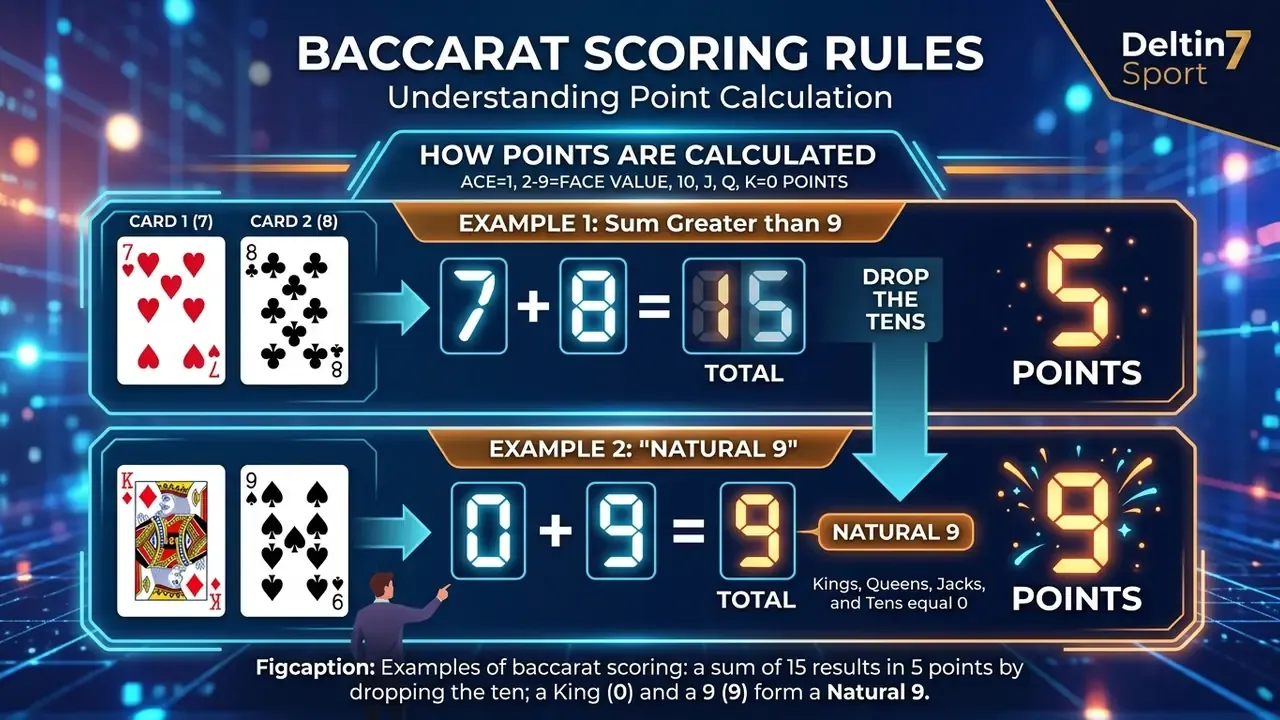
The simple version, no maths required. Point totals in baccarat can never go above 9. Add the cards together, and if the answer has two digits, ignore the first one and keep the last. Fifteen becomes 5. Eighteen becomes 8. Twenty becomes 0. That is the entire scoring system.

  • Example A: a hand of 7 and 8 totals 15. Drop the ten and the score is 5.
  • Example B: a hand of King (0) and 9 totals 9. The score is a Natural 9.
  • Example C: a hand of 6 and 4 totals 10. The score is 0, often called "baccarat".

A worked hand, as if you were sitting at the table. You place ₹500 on Banker. The dealer deals: Player gets 5♦ and 9♣ (5 + 9 = 14, so the score is 4). Banker gets Q♠ and 7♥ (0 + 7 = 7). Neither hand has 8 or 9, so there is no Natural. The Player is on 4, inside the 0 to 5 range, so the Player automatically draws a third card: 2♣. The Player now holds 4 + 2 = 6. The Banker stands on 7 by rule and never draws. Final score: Banker 7, Player 6. Banker wins. You are paid ₹500 at 1:1, minus the 5% commission of ₹25, for a net profit of ₹475.

For the mathematically minded, the same rule is written as a modulo-10 operation:

$$\text{Hand Score} = (\text{Card 1} + \text{Card 2} + \dots) \pmod{10}$$

You never need this notation to play a hand correctly. The software and the croupier apply it for you.

The simple version, no maths required

When a third card is dealt

If neither hand shows a Natural 8 or 9 on the first two cards, a fixed set of third-card drawing rules applies. The Player hand always acts first, then the Banker hand, according to standardised regulations published by bodies including the Gambling Regulatory Authority of Singapore and the California Bureau of Gambling Control.

Player third-card rules

  • If the Player's initial total is 0, 1, 2, 3, 4 or 5, the Player draws a third card.
  • If the Player's initial total is 6 or 7, the Player stands and draws nothing.

Banker third-card rules

If the Player stood, the Banker follows the same simple rule: draw on 0 to 5, stand on 6 to 7. If the Player drew a third card, the Banker's action depends on the Banker's current score and the exact value of the Player's third card:

  • Banker total 0, 1 or 2:Banker always draws.
  • Banker total 3:Banker draws unless the Player's third card was an 8.
  • Banker total 4:Banker draws if the Player's third card was 2, 3, 4, 5, 6 or 7.
  • Banker total 5:Banker draws if the Player's third card was 4, 5, 6 or 7.
  • Banker total 6:Banker draws if the Player's third card was 6 or 7.
  • Banker total 7:Banker always stands.
Banker third-card rules. If the Player

Banker draw and stand grid (when the Player took a third card)

Banker total ↓ / Player's 3rd card →0123456789
0–2DrawDrawDrawDrawDrawDrawDrawDrawDrawDraw
3DrawDrawDrawDrawDrawDrawDrawDrawStandDraw
4StandStandDrawDrawDrawDrawDrawDrawStandStand
5StandStandStandStandDrawDrawDrawDrawStandStand
6StandStandStandStandStandStandDrawDrawStandStand
7StandStandStandStandStandStandStandStandStandStand
baccarat banker third card rule decision chart
How the Banker's third-card rule is resolved

Because these rules are fully automated by the dealer or the software, you never need to memorise the table to play correctly. Understanding the asymmetry still helps, because it explains why the Banker hand holds a slight mathematical advantage: the Banker acts with information about the Player's third card.

Baccarat bets: Player, Banker, Tie and side bets

Baccarat offers three primary betting options, Player, Banker and Tie, alongside optional side bets that pay on specific card combinations. Every option carries its own payout odds, commission rules and house edge, and those determine long-run expected returns.

Choosing between main outcomes and side wagers means balancing payout potential against mathematical exposure. The core wagers include some of the lowest house edges in online casino gaming. The side wagers, almost without exception, do not.

Betting on Player, Banker and Tie

The standard baccarat table is built around three primary betting positions:

  1. Banker bet: a wager that the Banker hand beats the Player hand. Winning Banker bets pay 1:1 but carry a standard 5% commission (vigorish) collected by the house to offset the positional edge, giving a net payout of 0.95:1. The Banker bet carries the lowest house edge in standard baccarat at 1.06%, a figure confirmed by both Wizard of Odds and Nevada Gaming Control Board rule sets for 8-deck play with 5% commission.
  2. Player bet: a wager that the Player hand beats the Banker hand. Winning Player bets pay 1:1 with no commission deducted. House edge: 1.24%.
  3. Tie bet: a wager that both hands finish with equal totals. Standard Tie bets pay 8:1, or 9:1 at select tables. Because equal scores are infrequent, the standard 8:1 Tie carries a steep house edge of 14.36%, falling to roughly 4.84% under 9:1 payout rules.
Betting on Player, Banker and Tie

Raw outcome probabilities, before ties are returned

In a standard eight-deck game, the raw distribution of results is:

  • Banker wins:45.86%
  • Player wins:44.62%
  • Tie:9.52%
Raw outcome probabilities, before ties are

Exclude ties, since a Tie pushes your Player or Banker stake back, and the effective win probability for the Banker rises to 50.68%, with the Player at 49.32%. That 1.36% gap is exactly why casinos charge 5% commission on winning Banker bets. Without it, the Banker wager would be a positive-expectation bet for the customer, and no operator runs a table like that.

Side bets: the optional wagers around the main game

Side bets are independent optional wagers placed alongside a primary bet. They settle on specific initial card occurrences, regardless of which main hand wins the round.

"An analysis of more than 300 million player decisions shows that willingness to place high-edge side bets depends on accumulated winnings and bankroll size." UNLV Gaming Institute, "Know when to hold'em: Unpacking the determinants of table player win/loss and the elasticity of table house advantage" (2023). https://oasis.library.unlv.edu/gaming_institute/2023/May23/32/

In other words, side-bet appetite grows when players are ahead, which is exactly when the highest-edge wagers do the most long-run damage.

Common side bets across baccarat games online include:

  • Player Pair / Banker Pair:pays if the first two cards dealt to the named hand form a pair, such as 8-8 or Queen-Queen. Standard payout 11:1, house edge 10.36%.
  • Perfect Pair:pays if the first two cards of either hand form an identical pair in both rank and suit, for example two King of Spades. Standard payout 25:1 (sometimes 30:1), house edge 13.03% to 13.71%.
  • Either Pair:pays if either the Player or Banker initial hand contains a pair. Pays 5:1, house edge 13.71%.
  • Big / Small:"Big" pays if the round uses 5 or 6 cards in total (payout 0.54:1, house edge 4.35%). "Small" pays if only 4 cards are dealt (payout 1.5:1, house edge 5.27%).
  • Dragon Bonus:pays when your selected hand wins with a Natural 8 or 9, or wins by a margin of four points or more. The payout scales with the winning margin up to 30:1 on a nine-point non-natural win. It is the most player-friendly side bet on most tables, with a house edge of roughly 2.65% on Banker and 4.35% on Player.
  • Super 6 (side bet):pays 12:1 when the Banker wins with a final total of exactly 6. Despite the attractive multiplier, this is the worst wager on the felt at a 29.98% house edge. Do not confuse it with commission-free "Super 6" or "Punto 2000" tables, where a Banker win on 6 simply pays 0.5:1 rather than triggering a bonus.
  • Tiger / Small Tiger / Big Tiger:popular on Macau-style tables. The base Tiger bet pays 12:1 or 20:1 when the Banker wins with 6 points using two or three cards respectively.
Deltin7 Sport heading-banner

Characteristics of standard baccarat bets (8 decks)

Bet typeWinning conditionCommissionStandard odds / payoutHouse edge
BankerBanker hand score > Player hand score5% on wins1:1 gross (0.95:1 net)1.06%
PlayerPlayer hand score > Banker hand scoreNone1:11.24%
TiePlayer score equals Banker scoreNone8:1 standard, 9:1 select14.36% at 8:1
Player / Banker PairInitial two cards of the named hand form a pairNone11:110.36%
Perfect PairInitial two cards match in rank and suitNone25:113.03%
Either PairEither hand receives an initial pairNone5:113.71%
BigTotal cards dealt in the round is 5 or 6None0.54:14.35%
SmallTotal cards dealt in the round is 4None1.5:15.27%
Dragon BonusWin with Natural 8/9 or by a margin of 4+ pointsNoneUp to 30:1 (9-point margin)2.65% Banker, 4.35% Player
Super 6 (side bet)Banker wins with a final total of exactly 6None12:129.98%

Baccarat variants online: Punto Banco, mini baccarat and beyond

Online casinos carry multiple baccarat variants built around different player styles, stake preferences and game speeds. The scoring system stays constant across versions. Rules on commissions, card dealing and player decisions do not.

Understanding variant-specific mechanics prevents unpleasant surprises at payout time, such as the modified Banker payout on commission-free tables.

Punto Banco and mini baccarat for most players

Punto Banco is the standard, fully automated variant found across global platforms. Players never handle cards, and all drawing actions strictly follow preset rules.

Mini baccarat is a scaled-down version of Punto Banco engineered for fast digital play and smaller bankrolls:

  • Lower limits: table minimums often start at ₹50 to ₹100, well below traditional tables. Regulated rule books show how wide the range can be, from A$10 to A$5,000 in Australian Capital Territory approvals, down to $0.10 to $1,000 in Loto-Québec's published baccarat rules.

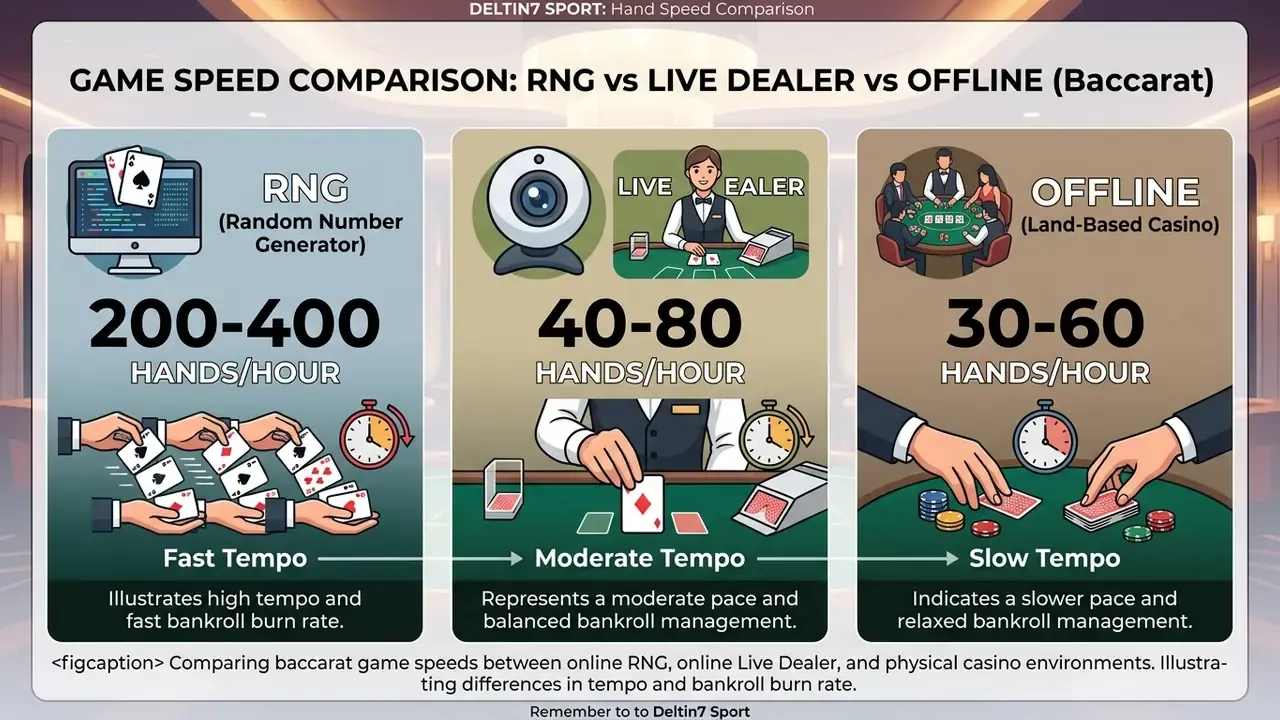
  • High game speed: rounds resolve rapidly, frequently 120 to 200 hands per hour on software tables, because the virtual dealer moves cards instantly.

    "In 2023 baccarat generated 41.28% of Las Vegas Strip table game revenue while representing just 16.08% of tables." UNLV Center for Gaming Research, "Las Vegas Strip Table Mix" (2023). https://gaming.library.unlv.edu/reports/strip_game_mix.pdf

    That revenue concentration explains why operators invest so heavily in baccarat variants and high-limit live studios.

  • No-commission (EZ Baccarat) variations: some mini baccarat games remove the 5% Banker commission. Winning Banker bets pay 1:1 instead, except when the Banker wins with a total of 6, which pays 0.5:1, or pushes under rules such as "Dragon 7". The house edge lands between 1.02% and 1.46%.

Punto Banco and mini baccarat for

Macau baccarat, Chemin de Fer and Baccarat Banque

Punto Banco dominates modern lobbies, but historical and regional variants keep distinct mechanics:

  • Macau baccarat:hugely popular across Asian gaming hubs. It uses standard Punto Banco point-counting and settlement, then adds custom side wagers such as the Tiger Bet, paying 12:1 or 20:1 on specific Banker wins of 6, plus card-squeezing features in live streams. One claim repeated widely online, that a Macau hand "goes bust" above nine, is simply wrong: totals over 9 have 10 subtracted exactly as in Punto Banco.
  • Chemin de Fer:the classic European variant where players take the Banker role on a rotating basis and wager against one another rather than the house. Unlike Punto Banco, a player holding a total of 5 may choose whether to draw. It is the only mainstream baccarat family with genuine strategic decisions, which is why it still attracts game-theory research.
  • Baccarat Banque:a traditional European format where one player holds the Banker position for an extended run, or until their bankroll is exhausted, dealing across two separate Player hands at once. In the Deux Tableaux layout, three two-card hands are dealt, two Player hands and one Bank hand, so instead of a Tie wager you back either Player hand or the Bank.
  • European baccarat:a regional rule set where the Player may stand or draw on a total of 5 and the casino funds the Banker position. If one player covers the Banker's bankroll, the remaining participants sit out that round.
Macau baccarat, Chemin de Fer and

Live dealer baccarat: how a live casino actually works

Live dealer baccarat streams real-time video of professional human dealers working physical tables from broadcast studios or land-based casino floors. You place wagers digitally through an interactive overlay, which puts online convenience and physical casino atmosphere in the same window.

This hybrid model relies on optical character recognition (OCR) and physical card scanners built into the dealer's shoe, converting physical card deals into instant digital data. That architecture is explicitly permitted and described in the UK Gambling Commission's Remote Gambling and Software Technical Standards (RTS 17) and in Connecticut's live dealer technical specifications.

Live dealer baccarat how a live

Inside a live dealer baccarat table

A modern studio for dealer baccarat combines physical casino hardware with high-speed digital processing:

  1. Optical card scanners: as the croupier slides a card from the shoe, a built-in barcode scanner or camera reads its suit and rank and transmits the data to the gaming server within milliseconds. Connecticut's 2023 technical specifications require card-reader decks to feed values into the gaming system as each card is dealt.
  2. Game Control Unit (GCU): a hardware device attached to each live table encodes the video feed and synchronises physical card scans with your digital interface, typically over WebRTC or low-latency HLS transport.
  3. Interactive UI overlay: you watch physical cards on screen while a digital layer lets you select chip denominations, place wagers on active betting areas, review trend roadmaps (Bead Plate, Big Road) and use text chat. Regulators permit a digital overlay to mark the Banker, Player and Tie wagering zones.
  4. Leading software providers: major studios supplying live baccarat include Evolution Gaming (known for Lightning Baccarat and Baccarat Squeeze), Pragmatic Play Live, Playtech and Ezugi. The latter two are heavily used on India-facing platforms, often with Hindi-speaking dealers.
Inside a live dealer baccarat table

Live baccarat, RNG play and land-based casinos: the key differences

Choosing a format usually comes down to three trade-offs: automated speed (RNG), visual immersion (dealer live streams), or physical presence (offline casino).

baccarat game speed comparison rng live dealer offline
Game pace by playing environment

Stream stability, in practice. Live baccarat is bandwidth-dependent, and the checks that matter to a player are simple: does the on-screen card match the scanned result, and does the betting timer close cleanly on your connection? Low-latency delivery paths such as WebRTC and low-latency HLS are designed to keep video and game data within a few seconds of real time on stable 4G or 5G connections, but the actual sync depends on your network, device and the operator's CDN. Any figure quoted by a review site, including ours, should be read as indicative rather than as a guaranteed service level. If your feed lags behind the betting window, drop the stream quality in the settings panel or move to an RNG table instead of guessing at a stale timer.

Stream stability, in practice. Live baccarat

Operational comparison: live vs RNG vs offline baccarat

ParameterLive dealer baccaratRNG baccarat (software)Offline land-based casino
Dealing mechanismHuman croupier with physical cardsCertified random number generatorHuman croupier with physical cards
Game speedMedium (40–80 hands/hour, up to 130 in Speed formats)Very fast (150–400 hands/hour)Slow to medium (30–60 hands/hour)
Atmosphere and trustHigh; physical card visibilityAbstract; digital graphicsHigh; physical presence and rituals
Betting limits rangeBroad, for example ₹100 to ₹500,000+Low to medium, for example ₹50 to ₹10,000Typically higher minimums (₹500+)
ConvenienceHigh; mobile and desktop accessMaximum; instant load, no waitingLow; requires travel and physical presence
Demo mode availabilityRare; usually observation onlyStandard; free play credits availableNone

How to choose a baccarat casino and evaluate an offer

Disclaimer: this information is general in nature and does not replace legal advice. Online gambling is regulated differently across jurisdictions. Confirm that play is lawful in your region before registering or depositing.

Selecting a reliable baccarat casino means auditing three things: the operator's licence, payment support for local currency such as INR, and whether promotional terms restrict table game play.

Because baccarat carries a low house edge, many commercial welcome offers exclude or heavily restrict baccarat wagers from bonus turnover targets. Read those terms before you register or deposit.

Criteria for evaluating baccarat online casinos

When reviewing baccarat online casinos for Indian users, run a strict four-point verification checklist. Cross-checking a shortlist of vetted online casinos against these points takes roughly ten minutes and prevents most payout disputes:

  1. Regulatory licensing: confirm active registration with an established authority such as the Curaçao Gaming Authority (CGA), the Malta Gaming Authority (MGA) or the UK Gambling Commission (UKGC). Public licence registries allow instant verification of domain legitimacy. Note that Curaçao's 2024 to 2026 reform replaced the old master and sub-licence structure, so any site still advertising a "sub-licence" is quoting outdated credentials.
  2. Software portfolio: check that the platform hosts certified tables from tier-one suppliers, for example Evolution, Playtech, Pragmatic Play and Ezugi, which is the practical baseline for stream quality and fair dealing.
  3. India-localised payment processing: verify native support for INR transactions through local rails including UPI (Unified Payments Interface), NetBanking, IMPS and leading e-wallets, to reduce cross-border conversion fees and payment friction.
  4. Transparent withdrawal policies: reliable platforms publish clear daily and weekly withdrawal limits, state processing timelines (e-wallets under 24 hours, UPI within hours), and list exact KYC requirements upfront.
Criteria for evaluating baccarat online casinos

🚩 Red flags: what puts a casino on a blacklist

Criteria that get an operator excluded from any serious shortlist:

  • Payout delays:cash-out processing drags past 72 hours with no documented KYC reason, or "pending" status resets after each support ticket.
  • Fake or unverifiable licences:no clickable regulator validator (CGA, MGA, UKGC) in the footer, or a licence number that returns no record in the public register.
  • Hidden wagering traps:a maximum cash-out cap on bonus winnings set below 2x the deposit, retroactive changes to terms, or "free" and "risk-free" wording on offers that actually require you to stake your own money, a practice explicitly banned by regulators such as the AGCO.
  • Unlicensed RNG software:uncertified clones of popular tables from unknown suppliers, or live tables with no provider branding.
  • Support and complaint patterns:unanswered player complaints, scripted or evasive support, and confiscated balances justified after the fact.
Red flags what puts a casino

How to check a bonus and welcome offer before registering

Promotional banners frequently advertise large match bonuses, "100% Welcome Bonus up to ₹50,000" and similar. The real value of an offer, though, lives in the fine print.

"Nine in ten online gamblers surveyed had received a promotional offer in the previous four weeks, and 76% of them used one." UK Gambling Commission, "Exploring consumer journeys using gambling promotional offers and incentives" (2023). https://www.gamblingcommission.gov.uk/statistics-and-research/publication/exploring-consumer-journeys-using-gambling-promotional-offers-and-incentives

  • Wagering contribution (game weighting):slots usually contribute 100% toward bonus wagering, while baccarat frequently contributes only 0% to 10%. At a 10% contribution rate, a ₹1,000 baccarat bet counts as just ₹100 toward clearing the requirement. Published terms show the full spread: some operators weight baccarat at 10% under live dealer games, others at 5%, and several at 0%.
  • Wagering multiplier:standard multipliers run from 25x to 45x the bonus amount. If baccarat is capped at 5% contribution, clearing a 30x bonus demands an extraordinary volume of wagers.
  • Maximum bet caps:active bonuses often enforce a maximum stake per hand, typically ₹400 (about $5), or a percentage such as 20% of the deposit. Exceeding the cap can forfeit bonus funds and any winnings attached to them.
  • Expiry windows and forfeiture:regulators including the Curaçao Gaming Authority require wagering requirements, expiry, forfeiture rules and withdrawal restrictions to be disclosed prominently and accepted before participation. If you cannot find them in two clicks, treat that as a red flag in itself.
Deltin7 Sport heading-banner

Bonuses, payments and security in online baccarat

Financial infrastructure decides whether a session ends with a smooth payout or a frozen ticket. Reliable baccarat platforms pair encrypted payment gateways with promotional terms you can actually read.

For Indian players, priority goes to platforms that support direct INR transactions and follow recognised data security standards.

How to compare bonuses and promotions for baccarat

To judge whether an offer holds real value for baccarat play, calculate its effective turnover cost:

$$\text{Required Wagering Volume} = \frac{\text{Bonus Amount} \times \text{Wagering Multiplier}}{\text{Baccarat Contribution Rate}}$$

  • Scenario A, favourable reload: ₹5,000 bonus with 20x wagering and 20% baccarat contribution = $\frac{5,000 \times 20}{0.20} = ₹500,000$ in total wagers.
  • Scenario B, unfavourable welcome offer: ₹5,000 bonus with 40x wagering and 5% baccarat contribution = $\frac{5,000 \times 40}{0.05} = ₹4,000,000$ in total wagers.

At a 1.06% Banker edge, Scenario B implies roughly ₹42,400 of expected theoretical loss to unlock a ₹5,000 bonus. That single calculation is why experienced baccarat players ignore most slot-oriented welcome packages.

VIP loss cashback is often materially better than a deposit match for baccarat players. Cashback rebates, typically 5% to 15% on net weekly losses, usually carry low wagering requirements of 1x to 5x, or none at all. That gives genuine downside protection without forcing inflated wager volumes. When comparing offers, confirm whether "cashback" is calculated on net losses or on net deposits, because the two definitions produce very different real values.

How to compare bonuses and promotions

"For every €1 invested in bonuses, players deposit €1.6; for every €1 of sponsorship, €4." "The impact of gambling advertising and marketing on online gambling behavior: an analysis based on Spanish data", Public Health (2024). https://pubmed.ncbi.nlm.nih.gov/39018681/

A useful reminder: promotions are an acquisition cost for the operator, recovered from deposits. Evaluate them as pricing, not as gifts.

Payment methods, withdrawals and security

Real-money baccarat needs authenticated payment channels and solid data protection, in line with the PCI Security Standards Council's PCI DSS v4.0 framework:

  • UPI and local Indian banking:UPI through PhonePe, Google Pay, Paytm or BHIM, plus NetBanking, allows instant INR deposits straight from an Indian bank account with no foreign currency conversion charge. RuPay cards and IMPS transfers are widely supported too.
  • E-wallets (Skrill, Neteller, MuchBetter):fast withdrawal processing, often inside 12 to 24 hours, and they keep your primary bank details separate from the casino operator.
  • Cards (Visa, Mastercard):convenient for deposits, but withdrawals commonly take 2 to 5 business days because of issuer settlement cycles.
  • Cryptocurrency (Bitcoin, USDT, Ethereum):rapid payout processing, minutes to about an hour, and high transaction limits. You do, however, take on token volatility and network transfer fees.
  • Security and encryption:reliable platforms deploy 256-bit SSL and comply with PCI DSS v4.0 to protect financial data in transit and at rest. Many now apply tokenisation or point-to-point encryption so raw card data never touches the operator's own systems.
Payment methods, withdrawals and security. Real-money

"Cryptocurrencies and prepaid cards carry the greatest AML risk because of the difficulty of verifying the source of funds." UNLV International Gaming & Casino Research Center, "Online Casinos, Alternative Payment Mechanisms and the Finance Crime Risks" (2024). https://www.unlv.edu/sites/default/files/media/document/2024-07/IGCR-OnlineCasinos-AlterPaymentMechanisms-FinanceCrimeRisks.pdf

Regulatory frameworks reinforce the point. Denmark's online casino inspection standard requires strong customer authentication for deposits, withdrawals and changes to payment instruments, while Canadian cashless standards require the payment instrument holder and the account holder to be the same person. Practical consequence for players: fund and withdraw using one method registered in your own name.

[❓ QUIZ: three questions to test readiness for real-money play. 1) Licence verified? 2) Baccarat wagering contribution checked? 3) Deposit limit set? Logic: three "yes" answers -> ready to deposit; any "no" -> recommend a pause.]
Purpose: interactive self-check before a deposit.
Semantics: <section role="form">; aria-labels; results as <dl>

Withdrawal friction, assessed honestly. Across India-facing platforms, two variables predict payout speed better than any marketing claim: whether the operator publishes an explicit verification checklist before your first withdrawal request, and whether your documents match the payment instrument exactly. Our own iGaming platform reviews document payment integration workflows and stated processing windows, and sites that front-load KYC generally clear payouts inside the published window instead of restarting the review at cash-out. We deliberately avoid quoting a single "hours saved" figure, because no operator publishes audited approval-time datasets. The honest comparison metric is the published timeline plus the documented KYC list, not a marketing average.

Regulatory frameworks reinforce the point. Denmark's

Baccarat for players in India: legality, taxes, UPI and KYC in one place

Disclaimer: the following summarises publicly available legal and tax information for general orientation only. It is not legal or tax advice, gambling law in India differs by state and is actively changing, and you should consult a qualified Indian legal or tax professional before playing or filing returns.

Tax: the 30% rule and TDS on net winnings

Since the 2023 to 2024 amendments, winnings from online games in India are taxed as a separate category:

  • A flat 30% tax applies to net winnings from online games under Section 115BBJ, plus applicable surcharge and cess. There is no basic-exemption benefit and no deduction for expenses.
  • TDS (tax deducted at source) under Section 194BA applies to net winnings at withdrawal and at year-end on the remaining balance, with no minimum threshold, unlike the older ₹10,000 floor for other winnings.
  • You must still report winnings in your income tax return even if TDS was already deducted, and losses cannot be set off against other income.
  • Offshore operators frequently do not deduct Indian TDS, which does not remove your reporting obligation. Keep transaction statements for every deposit and withdrawal.

Tax rules and thresholds change with each Finance Act. Verify current provisions with a chartered accountant before filing.

Tax the 30 rule and TDS

UPI deposits and a KYC checklist that prevents blocked withdrawals

The single most common cause of delayed payouts is a mismatch between account data and documents. Prepare the following before your first withdrawal request:

  1. Name consistency: the name on your casino account, your PAN, your bank or UPI account and your Aadhaar must match, including initials and spelling.
  2. PAN card: a clear colour scan. PAN is also the reference point for any TDS credit.
  3. Aadhaar or passport: used as photo ID. Mask the Aadhaar number where permitted and follow the operator's stated redaction guidance.
  4. Address proof: a recent bank statement or utility bill dated within the last three months. If your utility bill is not in English, expect a request for an alternative document, and a bank statement in English is usually the smoothest option.
  5. Payment proof: a screenshot of the UPI handle or bank account used for the deposit, in your own name. Never deposit through a family member's UPI ID. Third-party payments are the classic trigger for a frozen withdrawal.
  6. Selfie or liveness check: some operators require a photo of you holding your ID.

If a withdrawal stalls: request the exact list of outstanding documents in writing via live chat, re-submit in the requested file format, and note the ticket reference. If the published processing window has clearly passed, escalate through the licensing authority's complaints channel, since the CGA, MGA and UKGC all accept player complaints. Repeat tickets are the wrong move, because they can reset the review queue.

Typical INR mechanics to expect: minimum deposits from ₹85 to ₹1,000 depending on the platform, RNG table minimums around ₹50 to ₹100, live table minimums commonly ₹100 to ₹300, and e-wallet or UPI withdrawals inside 24 hours where KYC is already complete.

UPI deposits and a KYC checklist

Baccarat strategy: bet management and realistic expectations

Disclaimer: no betting system removes the mathematical advantage of the casino. This section is educational and is not financial advice.

No betting system and no mathematical strategy can eliminate the house edge built into baccarat. Every hand is an independent event, so betting progressions cannot alter the underlying probabilities. Roadmaps and trend grids are entertainment overlays: a shoe has no memory, and a run of Banker wins does not change the next hand's probability.

Responsible baccarat strategy therefore focuses on four controllable things: choosing low-edge wagers, controlling session length, managing the bankroll strictly, and respecting table limits.

The Martingale, Labouchere, Paroli, Fibonacci and d'Alembert systems

Players frequently apply progressive betting systems to baccarat's even-money wagers, Player and Banker. These systems reshape short-term profit distribution. They do not reduce long-term risk, and several of them amplify it:

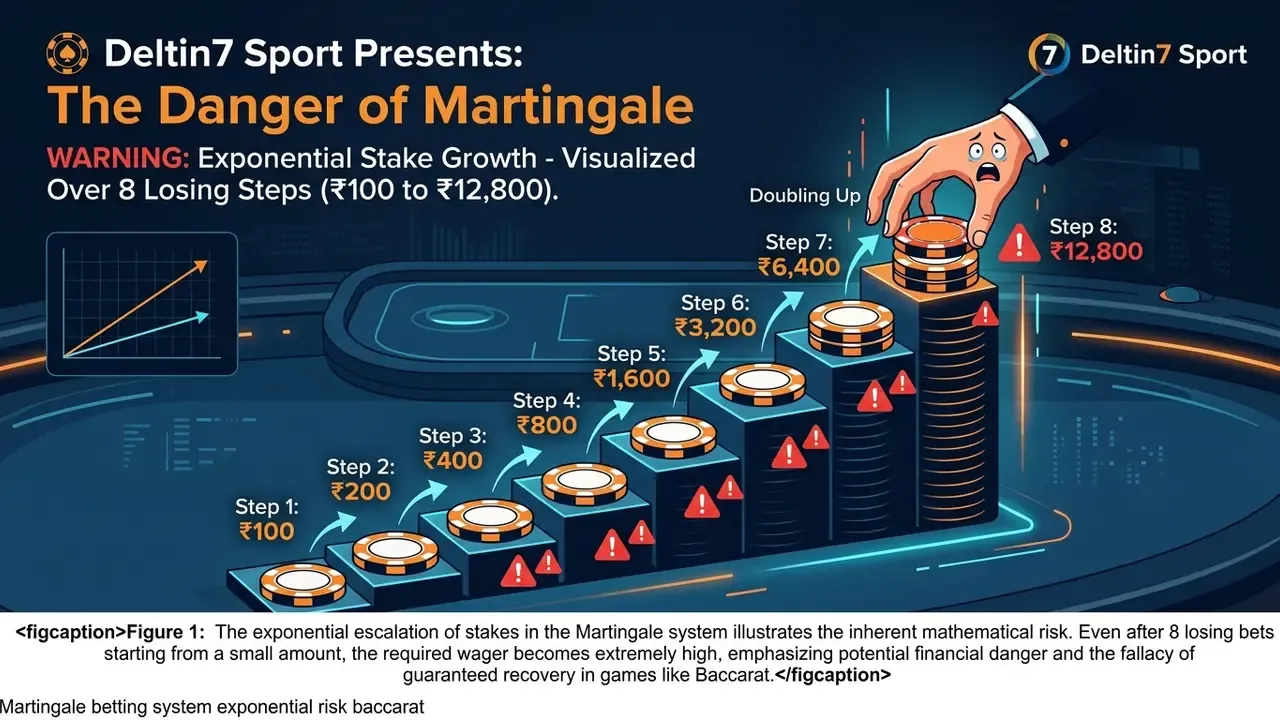
  1. Martingale (negative progression): double your bet after every loss and return to one base unit after a win.

    • The promise: a single win recovers all previous losses plus one unit of profit.
    • The risk: a streak of seven or eight consecutive losses inflates stake size exponentially (1 unit $\to$ 2 $\to$ 4 $\to$ 8 $\to$ 16 $\to$ 32 $\to$ 64 $\to$ 128 units), which hits the table maximum or wipes out the bankroll first.
  2. Labouchere (cancellation system): write a line of numbers, for example 1-2-3-4. Bet the sum of the first and last numbers. On a win, cross both off. On a loss, add the lost amount to the end of the line.

    • The risk: prolonged losing streaks lengthen the sequence quickly and force steep bet increases.

    "The Labouchère system produces a complex, heavy-tailed profit distribution indicating the risk of catastrophic losses over extended play." TU Dortmund, "Simple Martingale Betting versus Labouchere Betting at Roulette: Simulations and Statistical Evaluations" (2023). https://eldorado.tu-dortmund.de/items/92990134-2115-4ec4-8ec5-0cadcc3af8c9

  3. Paroli (positive progression): double your bet after each win for three consecutive wins, then reset to one base unit.

    • The advantage: it caps downside during losing streaks while capitalising on short winning runs.
  4. Fibonacci: follow the sequence (1, 1, 2, 3, 5, 8, 13, 21 and onward) after losses, then step back two numbers after a win.

    • The risk: growth is slower than Martingale, yet long losing streaks still push stakes beyond table limits.
  5. d'Alembert: add one unit after a loss, subtract one unit after a win.

    • The trade-off: the gentlest progression of the five, but it does not recover long losing runs, and table maximums still cap any recovery attempt.

Note also that the Kelly criterion, often cited in betting literature, produces no positive stake in baccarat, because there is no positive-expectation wager to size.

The Martingale, Labouchere, Paroli, Fibonacci and
martingale betting system exponential risk baccarat
How a negative progression collides with the table limit

Limits, house edge and staying in control with real money

Staying in the game over time depends on disciplined bankroll management rather than chasing loss recovery through progressions.

"Promotional offers lead to longer sessions and to the reinvestment of winnings into new bets, increasing overall monthly activity." UK Gambling Commission, "Exploring consumer journeys using gambling promotional offers and incentives" (2023). https://www.gamblingcommission.gov.uk/statistics-and-research/publication/exploring-consumer-journeys-using-gambling-promotional-offers-and-incentives

Fundamental bankroll rules for baccarat

  • Flat staking:limit each hand to 1% to 2% of your session bankroll. That protects your balance against ordinary statistical variance. Cap any single stake at roughly 5% and plan a session bankroll of 30 to 40 base bets.
  • Favour the Banker bet:at a 1.06% house edge, flat betting on Banker remains the statistically strongest choice over time.
  • Avoid the Tie bet:a 14.36% house edge erodes bankrolls fast over repeated play. The same logic rules out the Super 6 side bet at 29.98%.
  • Respect table limits:maximum stake caps are exactly what stops progressive doubling from working indefinitely.
  • Set fixed loss and win stops:establish a walk-away point before your first wager, for example stop after losing 30% of the session bankroll or after a 20% profit.
  • Set deposit limits in the account settings, not in your head.Regulated frameworks, including British Columbia's internet gambling standards and Danish Gambling Authority guidance, treat deposit caps as a core control precisely because in-session decisions are unreliable.
Fundamental bankroll rules for baccarat

Worked bankroll examples in INR

Session bankrollBase stake (1–2%)Practical table choiceStop-loss (30%)Stop-win (20%)
₹5,000₹50–₹100RNG mini baccarat (₹50 min)−₹1,500+₹1,000
₹10,000₹100–₹200Live baccarat (₹100 min)−₹3,000+₹2,000
₹25,000₹250–₹500Live or Speed baccarat−₹7,500+₹5,000
₹1,00,000₹1,000–₹2,000High-limit live tables−₹30,000+₹20,000

Remember the speed multiplier. At 200 RNG hands per hour with ₹100 flat Banker bets, you turn over ₹20,000 an hour and expose roughly ₹212 to the house edge. The same ₹100 stake on a 50-hand live table costs about ₹53 an hour in expected value. Table speed, not bet selection, is usually the biggest driver of how fast a bankroll disappears. That is the one detail most beginner guides skip.

Comparative analysis: baccarat vs roulette

ParameterLive baccarat (Banker bet)European roulette (single zero)
House edge1.06%2.70%
Maximum payout per round1:1 on main bets, up to 30:1 on side bets35:1 (straight up)
Influence of player decisionsNone; strict drawing rulesNone; number selection only
Game speed (live)40–80 hands/hour30–50 spins/hour
VolatilityLowLow (red/black) to high (single numbers)
Best forLow-variance, longer sessions on a fixed bankrollHigher-variance, lottery-style payouts

FAQ: quick answers about online baccarat

Is baccarat a game of skill?

No. Every drawing decision in Punto Banco is dictated by fixed rules, so the only choice you make is which bet to place. Chemin de Fer is the rare exception, where a player may decide on a total of 5.

Which baccarat bet is mathematically best?

The Banker bet, at a 1.06% house edge, even after the 5% commission. Player sits at 1.24%, and the standard 8:1 Tie at 14.36%.

Can I play live baccarat for free?

Rarely. Studio streams cost real money to run, so free play is normally limited to RNG tables and "First Person" software versions of live titles. Some lobbies do let you watch a live table without betting.

Do card counting or trend roadmaps work in baccarat?

No. Roadmaps display history, not probability. The theoretical edge available from counting an eight-deck baccarat shoe is far too small and too infrequent to be exploitable online, where shoes are often shuffled continuously.

How fast are withdrawals?

Crypto typically clears in minutes to an hour, e-wallets within 24 hours, UPI within hours to one business day, and cards in 2 to 5 business days. All of that assumes KYC is already complete.

Are online baccarat winnings taxable in India?

Net winnings from online games are taxed at a flat 30%, with TDS deducted at withdrawal and no minimum threshold. Confirm current rules with a tax professional.

What is the difference between commission-free baccarat and the Super 6 side bet?

On a commission-free table (Super 6 or Punto 2000), a Banker win on 6 pays 0.5:1 instead of the usual 1:1, and that replaces the 5% commission. The Super 6 side bet is a separate 12:1 wager on the same outcome, carrying a 29.98% house edge.

Before you deposit: a ten-point pre-play checklist

1
Licence number found in the footer and confirmed in the regulator's public register.
2
Live baccarat tables branded by a known provider, with the info panel showing paytable and limits.
3
Table minimum matched to a bankroll of at least 30 base bets.
4
Bonus terms located in two clicks: wagering multiplier, baccarat contribution, max bet, expiry, max cash-out.
5
Cashback calculated on net losses, not net deposits, if you plan to use promotions at all.
6
Deposit method registered in your own name, ideally UPI or NetBanking rather than a third-party wallet.
7
KYC documents prepared before the first withdrawal request, with names matching exactly.
8
Deposit and session limits set in account settings, not left to willpower.
9
Loss and win stop points written down before the first hand.
10
Tax position understood: flat 30% on net winnings, TDS at withdrawal, records kept.

Methodology, authorship and responsible play

This guide is compiled from primary regulatory rule sets (Nevada Gaming Control Board live baccarat rules, the Gambling Regulatory Authority of Singapore baccarat rule library, California Bureau of Gambling Control commission-free baccarat rules, Loto-Québec game specifications), technical standards (UK Gambling Commission RTS 17, GLI-17 and GLI-19, PCI DSS v4.0), and the peer-reviewed or institutional research cited inline. Payout percentages and house-edge figures are stated for standard eight-deck play, and individual tables may differ, so always read the game's info panel before betting.

Responsible gambling. Baccarat is entertainment with a negative expected value. Play only with money you can afford to lose, set deposit and session limits before you start, never chase losses, and keep gambling separate from borrowed funds. Age restrictions apply: 18+, or 21+ where local law requires. If gambling stops feeling like a choice, use the operator's self-exclusion tools and contact a local support service.

Methodology, authorship and responsible play. This