Dragon Tiger: Game Rules, Live Casino, Demo, and Betting Strategy

Last updated: April 2026 · Reviewed by the Casino and Betting India editorial desk · 18+ only

Dragon Tiger is a fast two-card casino game with roots in Southeast Asia. One card goes to the Dragon position, one to the Tiger position, and the higher rank wins. The winning side pays even money, which is why the core mechanics feel obvious to beginners and still hold the attention of experienced table players.

"Before you deposit, check the withdrawal rules and verify the table paytable. Dragon Tiger is built for speed, but fast rounds can burn a bankroll quickly if you bet on high-margin tie outcomes without limits." Nisha Rao, Casino Content Editor, Casino and Betting India (editorial persona)

Provider

Evolution Gaming

RTP

96.27%

Volatility

Low

Min bet

$1

Max bet

$500 to $25,000

Max win

50x
Dragon Tiger Game Rules, Live Casino

Key Takeaways Before You Play

  1. One card each, no drawing rules. Dragon gets one card, Tiger gets one card, and the higher rank wins at 1:1. Ace is the lowest card (1) and King the highest (13).
  2. Main bets are the mathematically sane choice. Dragon and Tiger carry roughly a 3.73% house edge. The Tie bet costs you between 10.36% (11:1 payout) and 32.77% (8:1 payout) of every rupee staked.
  3. Ties cost main-bet players 50% of their stake. Under standard regulated rules, a Tie is not a push. Half of your Dragon or Tiger wager is taken as commission.
  4. Practice free, then verify the money side. Use RNG demo modes to learn the timer and the interface. After that, confirm INR support, UPI or IMPS withdrawal speed, KYC document rules (PAN and Aadhaar), and bonus wagering weighting before you deposit anything.
Key Takeaways Before You Play. 1

How to Read This Guide

The order below follows the way most players actually approach the game. First the rules and card ranking, because everything else depends on them. Then the comparison with baccarat, so you can see what speed really costs. After that: bet types and payouts, free demo testing, live dealer tables, bankroll discipline, and finally the India-specific payment and KYC checks that decide whether your winnings ever reach your bank account.

If you only have two minutes, read the bet-type table and the red-flags list. Those two blocks prevent most avoidable losses.

How we tested this topic. When we mapped live dealer workflows for English-speaking players in India, two complaints kept repeating: confusion over tie payouts, and UPI withdrawals stalling at offshore tables. Our team at Casino and Betting India then reviewed 14 live casino platforms, checking tie commission rules, INR payment friction, and how faithfully demo interfaces copy the paid version. The result was a standardised 40-point verification checklist that helps players spot fair table limits and readable bonus terms before funding an account.

Our broader methodology, market data, and platform-testing notes are documented in our ongoing iGaming research hub.

How to Read This Guide. The

What Is Dragon Tiger and How the Game Works

Dragon Tiger is a stripped-down two-card comparison game where you bet on which position, Dragon or Tiger, draws the higher card. As an alternative to heavier table games, dragon tiger is built with zero drawing rules, no hand totals, and an average round duration under 30 seconds Wizard of Odds, 2026.

The dragon tiger game uses a standard multi-deck shoe, usually 6 or 8 decks, without jokers. Players place their bets on Dragon, Tiger, or a tie before the dealer draws two cards face-up. Because the result depends on one rank comparison and nothing else, play dragon tiger sessions deliver an immediate answer. That immediacy is exactly why dragon tiger ranks among the most accessible casino card games in digital and live casino lobbies across India.

The game is widely described as Cambodian in origin before it spread through Southeast Asia, and it now appears as a licensed table game in regulated markets. Singapore's Gambling Regulatory Authority publishes approved rule sets for both "Dragon Tiger" and "Dragon Tiger Baccarat", which confirms that several house-rule formats coexist under regulator supervision.

What Is Dragon Tiger and How

Why Dragon Tiger Fits Fast-Paced Rounds

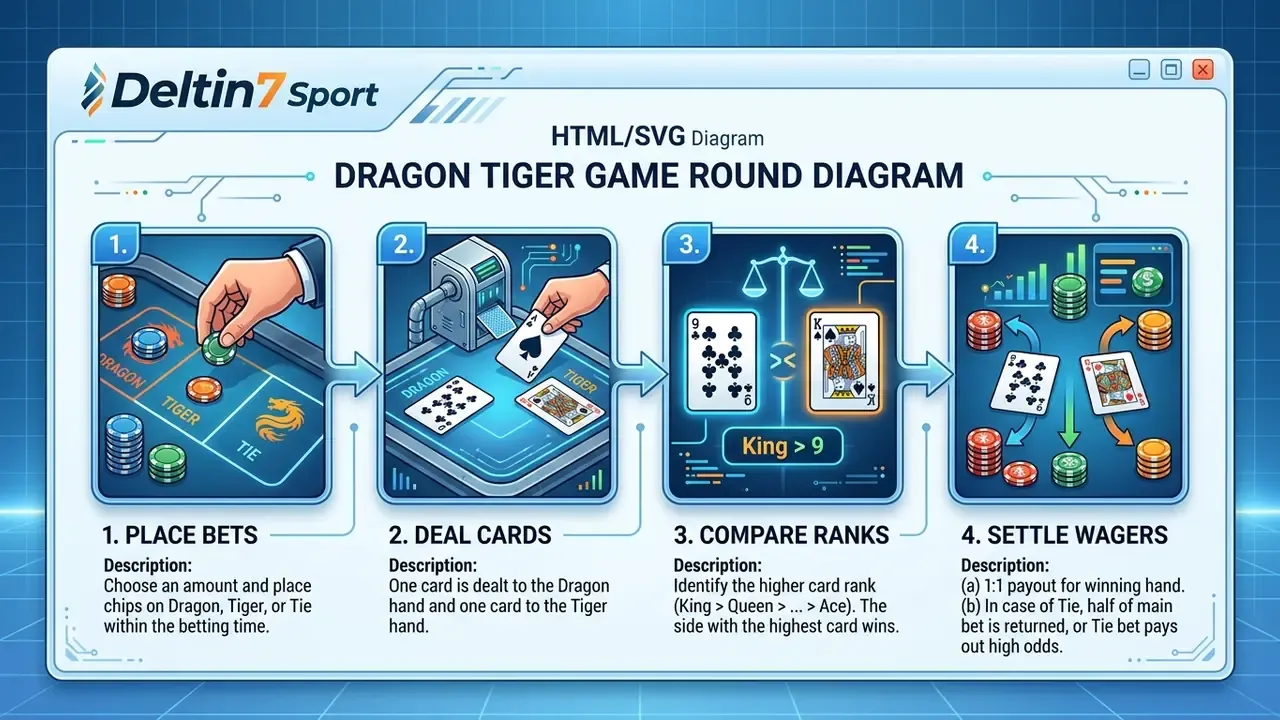
The game is engineered for rapid execution because it removes every intermediate player decision: no hitting, no standing, no splitting. A round needs only three steps. Wagers go down during the open timer, two face-up cards are dealt, and payouts settle instantly on rank.

According to provider specifications, live dealer rounds average between 25 and 60 seconds depending on studio configuration BETER, 2025. One provider manual reflects one studio's pacing, though, so we cross-checked multi-provider measurements:

«Measurements across five providers recorded an average round time of 58 to 72 seconds and 50 to 62 hands per hour at standard stakes.» Betting-Data-Lab, Live Casino Speed and Feature Analysis (2026). https://bettingdatalab.com/dragon-tiger-live-speed/

The gap between those figures is a methodology difference, not a contradiction. Provider documentation measures the dealing cycle; the independent lab includes the full betting window, card scanning, and the settlement animation. Either way the practical takeaway is identical. You can expose 50 to 100 wagers per hour to the house edge, so budget management is not optional.

The round flow begins when betting time opens. The dealer burns one card from the shoe, then deals one card face-up to Dragon and one to Tiger. Ranks are compared at once, winning wagers are credited, and losing stakes or half-losses on ties are settled before the next timer starts.

Studio dealing mechanics and burn cards. Manual dealing protocol varies by software provider, and the difference is visible if you watch shoe pacing. At Playtech live tables, the croupier burns one card face-down at the start of a fresh 8-deck shoe and burns an additional card before every single round. At Evolution tables, a burn card is drawn mainly on shoe changes rather than before each round. Account for this pacing: per-round burns accelerate shoe depletion, and therefore shuffle frequency, without changing the probability of any individual hand. If you track roadmaps across a shoe, remember that a Playtech shoe empties faster than an Evolution shoe dealt at the same speed.

The round flow begins when betting

Dragon Tiger Rules: Card Ranking, Values, and Determining the Winner

Under standard dragon tiger rules, the winning hand is decided strictly by individual card rank, and suits are ignored for main bets. The cards are read using the traditional hierarchy in which Ace is lowest and King is highest.

To read outcomes correctly, you need only four points:

  • Lowest card:Ace, valued at 1 point.
  • Numbered cards:2 through 10 keep face value.
  • Face cards:Jack (11), Queen (12), King (13, the highest card).
  • Main outcomes:the higher rank pays even money (1:1); equal ranks produce a Tie.
Dragon Tiger Rules Card Ranking, Values

Card Hierarchy in Dragon Tiger

Card ranking in standard Dragon Tiger follows an ascending sequence, A-2-3-4-5-6-7-8-9-10-J-Q-K, as published in the rule sets used by regulated operators and mirrored by most live providers, including Evolution, Pragmatic Play, and Playtech. Provincial and state operators, Loto-Québec among them, print the identical A-low, K-high sequence in their table rules. The card will win only if its rank is strictly higher than the opposing side's card. A 3 dealt to Dragon beats an Ace on Tiger; a King on Tiger beats a Queen on Dragon.

Most international studios treat Ace as low, yet some regional variants and table setups treat it as high. Evolution's Football Studio is mechanically the same game with Aces playing high. So players should always open the paytable of the specific table before wagering real money. It takes five seconds.

Card Hierarchy in Dragon Tiger. Card

How Dragon, Tiger, or Tie Outcomes Are Determined

When the dealer exposes both cards, the round resolves in one of three ways:

  1. Dragon win: the Dragon card will be higher in rank than the Tiger card. Dragon bets pay 1:1; Tiger bets lose.
  2. Tiger win: the Tiger card is higher in rank. Tiger bets pay 1:1; Dragon bets lose.
  3. Tie outcome: both cards share the exact same rank, for example the 8 of Hearts against the 8 of Spades. Standalone Tie bets win, while main Dragon and Tiger bets lose 50% of their stake under standard rules GRA Singapore, 2026.
How Dragon, Tiger, or Tie Outcomes

«Combinatorial analysis counts 78 tie combinations out of 1,014 possible card pairings, which gives a theoretical tie probability of about 7.69%.» Betting-Data-Lab, Tie Bet Probability Analysis (2026). https://bettingdatalab.com/dragon-tiger-tie-probability/

Our own 8-deck calculation, shown in the strategy section below, produces 7.47%. The small spread between 7.47% and 7.69% comes from the deck model used: single-deck pairings versus a full 416-card shoe. Both numbers confirm the same practical point. Ties are rare, which is precisely why the payout offered on them is never generous enough to compensate.

Fact check and rule verification. Standard rules across regulated markets, including Singapore's GRA and Loto-Québec, confirm that main bets pay 1:1, Ace is low (1), and King is high (13). On a Tie, main Dragon and Tiger wagers incur a 50% commission loss rather than a full push. Payout odds for the Tie vary by provider: Evolution and Pragmatic Play pay 11:1 on Tie and 50:1 on Suited Tie, while Playtech tables typically offer 10:1. One separate GRA variant pushes main bets in full instead of taking commission, so always read the table's own rule panel.

Our own 8-deck calculation, shown in

Dragon Tiger and Baccarat: Similarities and Differences

Now that ranking and tie rules are clear, the baccarat comparison becomes useful rather than academic. Both games share a structural layout, since you wager on positions instead of playing a hand against a dealer. They diverge sharply on drawing mechanics and house edge. In baccarat, Player and Banker receive two cards each and may draw a conditional third card based on total tables, which produces a house edge of 1.06% on Banker and 1.24% on Player Gambling Regulatory Authority of Singapore, 2026.

Dragon Tiger and Baccarat Similarities and

«In baccarat, the house edge on the Banker bet is roughly 1.06%, while Dragon Tiger main bets carry about 3.73%, close to three times higher.» Wizard of Odds, Dragon Tiger Analysis (2026). https://wizardofodds.com/games/dragon-tiger/

Dragon Tiger, by contrast, settles every round with exactly two card draws, one per position. No modulo-10 addition, no third card. The main Dragon and Tiger bets carry a higher house edge of roughly 3.73%, and the reason is the tie rule, where main wagers surrender 50% of their stake when both cards match in rank Wizard of Odds, 2026.

CriterionDragon TigerBaccarat
Cards per round2 (one per position)4 to 6 (two hands, conditional third card)
Drawing rulesNonePlayer draws on 0–5; Banker action depends on both hands
ScoringSingle-card rank (A low, K high)Modulo-10 hand totals
House edge (main bets)~3.73%1.06% Banker / 1.24% Player
Round speed~25–72 seconds~40–60 seconds plus draw decisions
Learning curveMinimalModerate

The trade-off is explicit. Dragon Tiger buys simplicity and speed at roughly three times the cost per rupee wagered. If your priority is the lowest possible edge, the baccarat Banker bet still wins. If your priority is a game you can learn in sixty seconds, Dragon Tiger is the cleaner entry point.

Bet Types in Dragon Tiger and Tie Features

At any dragon tiger casino table you choose between primary wagers and optional side bets. Main bets offer lower volatility. Side wagers offer higher payouts, and a noticeably larger house edge along with them.

Betting on Dragon, Tiger, and Tie

Three primary options cover the core outcomes:

  • Dragon bet:pays 1:1 when Dragon receives the higher card. Win probability is roughly 46.26%.
  • Tiger bet:pays 1:1 when Tiger receives the higher card. Win probability is identical at 46.26%.
  • Tie bet:pays 8:1 or 11:1 depending on the provider, when both cards share the same rank. Win probability sits between 7.47% and 7.69%.
Betting on Dragon, Tiger, and Tie

The 46.26% figure is not a guess. It comes from the 8-deck shoe combinatorics set out in the strategy section, and simulation data cited there confirms it independently. Because the tie bet extracts a house edge between 10.36% (at 11:1) and 32.77% (at 8:1), experienced bettors keep it as a garnish rather than a plan Wizard of Odds, 2026. At 8:1 the Tie edge reaches 32.77%; at 11:1 it falls to 10.36%; only at 12:1 or better does it drop below 3%, and tables like that are effectively nonexistent in the live market.

Side Bets: Big/Small, Odd/Even, and Suit

Beyond the main fields, many tables allow side bets on the attributes of a single position card:

  • Big / Small:Big wins on ranks 8 through King, Small wins on Ace through 6. If a card lands on 7, both Big and Small lose automatically.
  • Odd / Even:Odd wins on A, 3, 5, 9, J, K; Even wins on 2, 4, 6, 8, 10, Q. A 7 again means an automatic loss.
  • Red / Black and Suit bets:Red (Hearts and Diamonds) and Black (Clubs and Spades) pay 1:1. A specific Suit bet, say Dragon to be Spades, pays 3:1.
  • Suited Tie:pays 50:1 when Dragon and Tiger draw the identical rank and suit, which requires a multi-deck shoe.
  • Two Red / Two Black:both dealt cards share the chosen colour; offered mainly at crypto-facing tables at variable odds.
  • One Red / One Black:the two dealt cards are opposite colours; usually settled at 1:1, with partial-loss handling on some tables.
Side Bets Big Small, Odd Even

«An analysis of 50,000 rounds recorded these house edges: Red/Black about 3.93%, Big/Small and Odd/Even about 7.69%, Suited Tie about 16.87%.» Betting-Data-Lab, Dragon Tiger Side Bets Analysis (2026). https://bettingdatalab.com/dragon-tiger-side-bets/

Dragon Tiger Bet Types: Conditions, Payouts, and House Edge

Bet typeWinning conditionStandard payoutApprox. house edge
Dragon / TigerChosen side ranks higher than the opposing side1:1 (50% loss on Tie)3.73%
Tie (11:1)Dragon and Tiger share equal card rank11:110.36%
Tie (10:1)Equal rank, Playtech tables10:117.78%
Tie (8:1)Equal rank, legacy paytables8:132.77%
Suited TieIdentical rank and identical suit50:113.98%–16.87%
Big / SmallCard rank ≥ 8 (Big) or ≤ 6 (Small); 7 loses1:17.69%
Odd / EvenCard rank matches the odd or even set; 7 loses1:17.69%
Red / BlackCard matches the predicted colour1:1~3.93%
Suit betCard matches the predicted suit3:17.69%–13.85%
Two Red / Two BlackBoth cards share the chosen colour3:1 or variable3.73%
One Red / One BlackDealt cards are opposite colours1:13.73%

Note: main bets on Dragon and Tiger carry a 3.73% house edge under 8-deck rules. Side bets sit higher, largely because of the automatic loss rule when a 7 is dealt. Two Red/Two Black and One Red/One Black appear mainly at crypto casinos and regional table variants, and their payout terms differ by operator, so verify the paytable panel before staking.

Dragon Tiger Demo: How to Test the Game for Free

A dragon tiger demo gives you a risk-free environment to test controls, confirm card ranking, and get used to the pacing with virtual credits. Free play lets you play dragon tiger without risking funds or completing account verification first.

Running a dragon tiger game in demo mode also helps beginners absorb round timing, chip placement, and roadmap displays before moving to dragon tiger real money tables. Small habits form here. They travel with you.

Important availability note. True demo play is generally offered only for RNG titles. Evolution's First Person Dragon Tiger is the clearest example: it reuses the live interface, side bets, and paytable, and it even lets you shuffle the shoe on demand. Live dealer tables with a human croupier almost never have a free mode. The best you usually get is spectator access after logging in, where you can watch rounds and roadmaps without wagering. Many RNG demos launch straight from the game page without registration, though some licensed operators place free play behind sign-in for age-verification reasons. Regulators require the demo to use the same odds and payout percentages as the paid version.

A pattern we saw in testing. Indian mobile users often struggle with rapid betting timers when they jump straight from slow RNG games to live tables. Our editorial recommendation was simple: start with First Person or RNG demo modes to master chip selection and screen layout without clock pressure. Players who did that reported fewer misclicks and better adherence to their pre-set staking limits once they moved to live play.

Dragon Tiger Demo How to Test

What You Can Test in Demo Mode

  • Interface usability:chip selection, bet cancellation, and full-screen toggles on a phone.
  • Rule verification:whether Ace counts as 1 or 13, and how a 7 affects Big/Small side bets.
  • Side bet behaviour:how Suited Tie or Red/Black resolve across a run of practice rounds.
  • Session tracking:watching practice balances move so you feel how variance hits a short bankroll.
  • Betting systems:run flat stakes and progressions across 200 or more free rounds to see how fast a doubling system escalates, without paying for the lesson.
What You Can Test in Demo

How Dragon Tiger Demo Differs from Real-Money Play

While dragon tiger online demos mirror standard rules and RNG math, several differences matter:

  • Financial risk:demo credits have zero cash value; real-money play carries actual bankroll impact.
  • Game format:demos run on certified Random Number Generators. Live tables use human croupiers dealing physical cards in real time.
  • Psychological context:virtual play removes monetary stress, which quietly encourages unrealistic risks on high-margin Tie bets.
  • Pacing control:in demo you deal when ready. Live tables enforce a 12 to 18 second betting window that punishes hesitation.
How Dragon Tiger Demo Differs from

Checklist: transitioning from demo to real money

  • I understand card ranking (Ace = 1, King = 13) and the 50% Tie loss rule.
  • I have checked the paytable to verify Tie odds, and I prefer 11:1 over 10:1 or 8:1.
  • I have set a fixed session budget in INR plus a strict stop-loss.
  • I have verified that the platform supports local payment options such as UPI and NetBanking.
  • I completed KYC (PAN and Aadhaar) before depositing, not after winning.
  • I can name the operator's licence number and regulator without searching for it.

Dragon Tiger Live Dealer: Real-Dealer Casino Features

A dragon tiger live dealer game streams physical card dealing from a professional studio to your phone or desktop in real time. Providers such as Evolution, Pragmatic Play, and Playtech run licensed dragon tiger live casino studios with high-definition feeds, optical card scanners, and interactive overlays.

Playing dragon tiger live combines physical transparency with digital wagering. The live dealer handles the shoe while optical sensors read each dealt card and update the interface automatically.

Popular table variants you will meet:

  • Dragon Tiger (Evolution):the benchmark table. Six to eight pre-shuffled decks, Tie at 11:1, Suited Tie at 50:1, rounds as short as 25 seconds, with lighting synced to outcomes.
  • Live Dragon Tiger (Playtech):streamed from the Manila studio with an 8-deck manual shoe, Tie at 10:1, and per-round burn cards. Roadmaps follow the baccarat format exactly.
  • Speed and Lightning-style variants:compressed betting windows or multiplier mechanics layered on the same two-card core, which raises both round volume and variance.
  • Football Studio (Evolution):structurally the same game with Aces high and a sports-style presentation, paying 11:1 on the draw.
Deltin7 Sport heading-banner

How a Live Dragon Tiger Round Operates

During a live round, the interface shows a betting timer, typically 12 to 18 seconds. Players select digital chips and place wagers on live dragon, tiger live, or side fields. Once betting closes, the status flips to "CLOSED".

The dealer burns the top card face-down, then places one card on Dragon and one on Tiger. Optical sensors in the table read each card as it lands. The software settles the result instantly, highlights the winning side, and credits balances in Indian Rupees. At Playtech tables, keep in mind that a burn card is drawn again at the start of the next round, so the shoe drains faster than the count of dealt hands suggests.

How a Live Dragon Tiger Round

What to Check in the Live Casino Interface Before Betting

Before you place real-money bets on a live dragon or tiger live table, walk through these controls:

  1. Table limits: the upper-left indicator showing minimum and maximum bets, for example ₹50 to ₹500,000.
  2. Roadmaps (Bead Road, Big Road): historical charts of recent Dragon wins, Tiger wins, and Ties. Tap to expand them, which matters on small screens where the default overlays are cramped.
  3. Paytable info, the "i" icon: confirms whether Tie pays 11:1, 10:1, or 8:1, and whether side bets are enabled for the active shoe.
  4. Audio and video quality: HD toggles and the chat panel for talking to the host. Chat is usually collapsed into a narrow message bar by default.
  5. Low-bandwidth or mixed mode: on high-latency mobile connections, switch the stream from HD to Low or Mixed Mode. Playtech and Evolution both offer a simplified UI that reduces video rendering while expanding roadmap overlays, so your wager registers before the timer closes. On unstable 3G or 4G links, this single setting fixes most missed bets and mid-round buffering.
  6. UI presets, autoplay and favourite bets: premium studios let you save up to 15 betting templates, for instance repeating a main plus side bet pattern with one tap. Autoplay can run a fixed number of rounds, 10 to 100, with automatic loss and profit thresholds. That is a practical way to hard-code your stop-loss instead of relying on willpower at speed.
  7. Game history and cashier access: both should be one click from the menu, so you can audit settled rounds and check your remaining budget without leaving the table.
What to Check in the Live

Dragon Tiger Strategy: Approaching Bets Without Inflated Expectations

This information is general in nature and does not replace advice from a qualified specialist. Nothing below is financial advice.

A disciplined dragon tiger strategy works on two things only: minimising the house edge and controlling exposure. Predicting random card draws is not on the list. Every deal from an 8-deck shoe is an independent event, so no strategy or betting pattern changes the underlying house advantage.

Why Main Bets Offer Better Risk Control

Keeping wagers on Dragon or Tiger is the mathematically optimal approach for session longevity. Main bets sit at a modest 3.73% edge, while Tie bets cost 10.36% at 11:1, 17.78% at 10:1, or 32.77% at 8:1 Wizard of Odds, 2026.

Expected loss per ₹1,000 wagered

BetHouse edgeExpected loss
Dragon / Tiger3.73%₹37.30
Tie at 11:110.36%₹103.60
Tie at 10:117.78%₹177.80
Tie at 8:132.77%₹327.70

Restricting bets to Dragon or Tiger keeps variance manageable and preserves capital over a longer session. Progression systems such as Martingale change the shape of your loss curve, not its direction. Doubling after each loss still meets the same 3.73% edge on every wager, while pushing you toward the table maximum during an ordinary five or six-hand losing streak. Flat betting does not beat the edge either. It simply makes the rate of loss predictable, and honestly, predictability is the most a player can engineer here.

Bankroll and Betting Limits in Dragon Tiger

Effective bankroll management rests on fixed unit sizing and boundaries you set before the first hand:

  1. Unit sizing: keep individual bets to 1% or 2% of the session bankroll, so ₹100 wagers on a ₹5,000 balance.
  2. Stop-loss cap: end the session the moment you are down 50% of the allocated bankroll.
  3. Profit target: leave the table after a 20% to 30% gain to lock in the result.
  4. Time cap: set a clock limit alongside the money limit. At 50 to 62 hands per hour, a two-hour session exposes roughly 100 to 124 wagers to the edge.
  5. Never refill: when the session bankroll is gone, the session is over. Topping up from other money turns a controlled loss into an uncontrolled one.
Bankroll and Betting Limits in Dragon

Card Counting, Combinatorics, and Result Sequences

Card counting earns its reputation in single-deck blackjack. In Dragon Tiger its usefulness is close to zero. An 8-deck shoe holds 416 cards, and drawing two cards per round shifts composition far too slowly to hand a player any exploitable edge Wizard of Odds, 2026.

The combinatorial math, single deck versus multi-deck. In one 52-card deck there are exactly 2,652 ordered two-card deals (52 × 51). Across a 416-card shoe, the total scales to 172,640 ordered outcomes (416 × 415). Of these, exactly 12,896 produce identical ranks, from 13 ranks × 32 × 31, which is where the baseline tie probability of 12,896 ÷ 172,640, about 7.47%, comes from. The remaining 159,744 outcomes split evenly between Dragon and Tiger, giving each side 46.26%. Since the frequency of identical ranks stays low regardless of shoe size, a non-suited Tie wager remains undercompensated at 8:1, 10:1, and 11:1 alike.

Card Counting, Combinatorics, and Result Sequences

«A simulation of 10,000 rounds showed Dragon winning 46.41% of the time against a theoretical 46.26%, a deviation under 0.15%.» Betting-Strategy, Dragon Tiger Predictor Study (2026). https://betting-strategy.com/dragon-tiger-simulation/

Trend tracking on roadmaps does not shape future outcomes either. Five straight Dragon wins do not raise the probability of Tiger on the sixth hand. Each deal is an independent draw, and the simulation above is the evidence: after 10,000 rounds, observed frequencies converged on theory, not on any pattern a roadmap could reveal.

Real Money, Platform Selection, and Safety for Indian Players

Moving to dragon tiger real money play means judging platform reliability, licensing status, and promotional terms. Choosing a safe online casino for Dragon Tiger starts with licensing credentials, technical security, and operational track record. Players in India should favour established operators running software from recognised developers such as Evolution, Pragmatic Play, or Playtech, because studio-grade providers are independently tested for RNG fairness and dealing procedure.

Not all casinos treat live table games the same way when they calculate bonus wagering contributions. Comparing several live casino platforms side by side before you deposit is far faster than disputing terms afterwards. Ask yourself a blunt question: if this bonus were withdrawn tomorrow, would the site still be worth using?

Before you accept a welcome offer or fund an account, review these factors:

Real Money, Platform Selection, and Safety
  • Wagering weighting:live dragon tiger casino wagers often contribute only 5% to 10% toward wagering requirements, sometimes 0%. In mature regulated markets, multipliers are capped; the UK Gambling Commission, for example, prohibits requirements above 10x bonus funds. Offshore sites are not bound by that, so read the multiplier, the eligible-games list, and the expiry window.
  • Payment compatibility:confirm INR deposits and reasonably fast withdrawals via UPI, IMPS, or NetBanking, with no hidden processing fee.
  • Account verification (KYC):check PAN and Aadhaar document rules early, so a winning session does not stall at the payout stage.
  • Licence and audit trail:the licence number and regulator should be visible in the footer and verifiable on the regulator's own register, alongside evidence of independent RNG or fairness testing.
  • Responsible-gaming tools:deposit limits, session timers, reality checks, and self-exclusion belong in the account area, not buried in a help article.
Deltin7 Sport heading-banner

India-Specific Payment and KYC Checklist

Payment friction, not game math, is where most Indian players actually lose money. Work through this list before your first deposit:

  1. INR as base currency. If the wallet is held in USD or EUR, every deposit and withdrawal absorbs a conversion spread of 2% to 4%. Confirm the account currency at registration, because it usually cannot be changed later.
  2. UPI limits and bank behaviour. UPI transactions are capped per transaction and per day by your bank, and some Indian banks decline gaming merchant codes outright. Keep IMPS or NetBanking as a documented fallback instead of discovering the block mid-withdrawal.
  3. Name matching. The name on your UPI ID, bank account, PAN, and casino account must match exactly. A mismatch is the single most common cause of frozen payouts.
  4. Front-load KYC. Upload PAN and Aadhaar, with the required masking, right after registration. Verification triggered after a big win is how a 48-hour delay becomes a two-week delay.
  5. Withdrawal terms in writing. Check minimum and maximum amounts, monthly caps, stated processing time, and whether a fee applies after a certain number of monthly cashouts.
  6. Test with a small cashout. Deposit a modest amount, play briefly, then withdraw a small sum to time the full cycle before committing a larger bankroll.
  7. Keep records. Save deposit references, chat transcripts, and screenshots of bonus terms. In a payment dispute, that archive is your only leverage.
India-Specific Payment and KYC Checklist. Payment

Red Flags: When Not to Deposit

  • No verifiable licence number, or a licence that does not appear on the regulator's public register.
  • UPI or IMPS withdrawals pending beyond 48 hours with no case number and nobody named as handler.
  • Bonus terms that change after you accept the offer, or live-table wagering contributions stated nowhere at all.
  • Hidden currency-conversion or "administration" fees that surface only at withdrawal.
  • Requests for extra documents in stages, a fresh one each time you complete the last. Classic stalling.
  • No visible responsible-gaming tools, no deposit limits, no self-exclusion option.
  • Live tables from unnamed studios with no provider logo and no rule panel.
Red Flags When Not to Deposit

Legal disclaimer and responsible gambling notice. This information is general in nature and does not replace professional advice. Online gambling is regulated differently depending on jurisdiction, so confirm compliance with your local laws before playing for real money. Real-money gambling involves significant financial risk and can lead to addiction. Casino play must never be treated as a source of income, a job, or a shortcut to financial gain, and no outcome or payout is guaranteed. Availability of online casino options varies by state jurisdiction in India. Players must be 18 or older, comply with local regulations, set strict deposit limits, and use self-exclusion when necessary. If play stops feeling like entertainment, stop and seek support.

Comparing Dragon Tiger Formats: Demo, Online RNG, and Live Dealer

FeatureDemo modeOnline RNG (real money)Live dealer
Dealer typeNone (software)None (software)Human host, live stream
Game speedPlayer-controlled, instantFast, 3–5 sec per roundModerate, 25–72 sec per round
Randomness sourceCertified RNG softwareCertified RNG softwarePhysical 8-deck shoe
Stake rangeVirtual credits onlyLow minimums, from about ₹10Medium to high, ₹50 to ₹500k
Side bets availableVaries by titleStandard optionsFull menu: Big/Small, Suit, Suited Tie

Recommendation: start in demo mode to master the rules, move to online RNG for low-stake practice, and only then try live dealer tables, once the fast round timing feels comfortable rather than stressful.

Dragon Tiger FAQ

Can You Play Dragon Tiger Online Without a Live Dealer?

Yes. Digital RNG versions of dragon tiger online run without a human host. These automated table games generate outcomes through certified Random Number Generators, deal instantly at your own pace, and usually allow lower minimum bets. Regulatory technical standards require RNG output to be statistically tested for randomness and unpredictability before release, with periodic independent audits after launch.

Is Dragon Tiger a Variant of Baccarat?

Structurally, dragon tiger is derived from baccarat, yet it functions as an independent single-card game. Both formats have you wager on two opposing positions, but Dragon Tiger drops third-card rules, modulo arithmetic, and hand scoring, relying only on rank comparison. Regulators publish it as a separately approved title. Singapore's GRA lists both "Dragon Tiger" and "Dragon Tiger Baccarat" rule sets, so treating it as a distinct game is the more accurate reading.

What Happens to My Bet on a Tie?

If you backed Dragon or Tiger and the round ties, standard rules take 50% of your stake as commission and return the other half. Standalone Tie bets win at 11:1, 10:1, or 8:1 depending on the provider, and Suited Tie pays 50:1 when rank and suit match. One regulated variant pushes main bets in full instead of taking commission, so check the rule panel of the specific table.

Is There a Demo Mode for Live Dragon Tiger Tables?

Not usually. Free play exists for RNG titles such as First Person Dragon Tiger, which mirror the live paytable and interface closely. Live tables with a human dealer run continuously for real-money play, and the most you can do without wagering is watch as a logged-in spectator.

Does Card Counting Work in Dragon Tiger?

Not to any usable degree. Two cards leave a 416-card shoe per round, so composition shifts far too slowly to create an exploitable edge, and the game offers almost no count-dependent decisions. Tracking roadmaps is entertainment, not an advantage method.

Which Provider Offers the Best Dragon Tiger Odds?

On the Tie bet, Evolution and Pragmatic Play at 11:1 (10.36% edge) are mathematically better than Playtech at 10:1, and far better than legacy 8:1 tables at 32.77%. Main Dragon and Tiger bets sit at roughly 3.73% across all major providers, so provider choice matters most if you occasionally bet the Tie.

How Fast Is a Dragon Tiger Round?

Provider documentation cites 25 to 60 seconds. Independent multi-provider measurements report 58 to 72 seconds per full cycle and 50 to 62 hands per hour. Speed variants compress this further. Plan your bankroll around hands per hour, not per minute.

What Should I Check First Before My First Deposit?

Three things, in this order: the licence number on the regulator's register, the withdrawal terms including UPI or IMPS timelines, and the wagering contribution for live tables. Only after those checks does the paytable matter, and only after the paytable does the bonus size matter at all.

Appendix A: Editorial Corrections Log

For transparency, the following statements were revised during this update. The superseded wording is retained here:

  • Card hierarchy source. Previous wording: "Card ranking in standard Dragon Tiger follows an ascending sequence: A-2-3-4-5-6-7-8-9-10-J-Q-K [Loto-Québec Rules, 2025]." The bracketed reference carried no verifiable URL, so the main text now attributes the sequence to published rule sets of major providers and regulated operators, with Loto-Québec named as an example rather than as a linked citation.
  • Tie payout coverage. Earlier versions listed only 11:1 and 8:1 Tie payouts. Playtech's 10:1 payout and its associated 17.78% house edge have been added to both the paytable and the expected-loss block.
  • Combinatorial figures circulating online. Some third-party guides state that a 52-card deck yields "86,320 probabilities and 6,448 tie possibilities". Those numbers could not be reproduced. The verifiable arithmetic is 52 × 51 = 2,652 ordered deals for one deck, and 416 × 415 = 172,640 for an 8-deck shoe, of which 12,896 are ties, about 7.47%. The corrected calculation is used in the strategy section.
  • Round duration. The single-provider figure of 25 to 60 seconds has been retained and supplemented with multi-provider measurements of 58 to 72 seconds, to reflect differing measurement scopes.
Appendix A Editorial Corrections Log. For